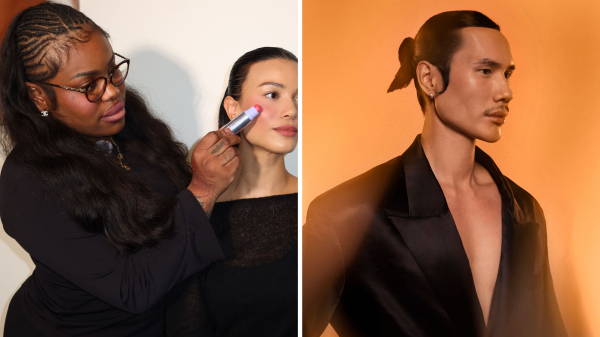
 Images: Courtesy of Kosas; Patrick Ta BeautySave this storySave this story
Update, June 16, 2026: Patrick Ta is sharing his side of the transition blush story. The makeup artist appeared on Emma Grede's podcast Aspire and directly responded to the controversy regarding his Transition Blush product launch and accusations of copying Painted by Esther's (Ngozi Esther Edeme) signature technique or not properly crediting her for helping popularize the ombré style for a new generation of makeup lovers.
In the interview, Ta told Grede that his Transition Blush line was created for the “blush lover" and the “world-building of blush,” given it's one of his favorite products and something his brand is well-known for. At first, he says he did “not understand” the conversation about Painted by Esther and creators not being recognized for their influence—especially Black creators and artists.
“The intent of this launch was never to take ownership over this technique,” Ta explained. “It was to create a product to simplify this artist technique that people have been doing and simplifying it for the consumer.” But after he took a step back to listen, he realized that “even though it wasn't my intention, the impact matters.”
Ta also claimed that his team reached out to Edeme for a potential collaboration prior to the launch, which she declined. “I personally reached out to Esther, my team reached out to Esther, and unfortunately she declined the opportunity because she wasn't taking paid collaborations at the moment,” he told Grede. “I really just wanted to work with creators that loved blush." He then went on to say that the launch has been “very difficult" for him.
Grede noted a “sense of remorse” from Ta while summarizing what went wrong. “It feels to me, Patrick, like you kind of understand that launching this particular product without a mention of her influence of the technique kind of felt like an erasure of her influence,” she said, adding that Edeme has been “very vocal” about how she didn't create the technique (as we reported below), but has definitely added to its current relevance. “But the fact that you guys went out with it in the way that you did feels like she should have somehow come up and been credited, and she wasn't. And because it so frequently happens, specifically with Black female creators and artists, it has escalated into something that is disproportionate to what you would have perhaps hoped for considering that you went out to her.”
Ta agreed. “I am genuinely sorry for the hurt and the frustration that I have caused and that for anyone who has ever felt overlooked or not recognized on their contributions; that was never my intent,” he said. “My intent was only to create a product to allow people to make this technique more accessible at home.”
As for accusations of copying a specific video of Edeme's, Ta said that was just a coincidence. According to the makeup artist, he filmed his video months before it appeared online. “Her content came out just a week prior, so there's no way that I could have copied her.” He then told Grede that since the controversy began, he has reached out to Edeme for a “conversation, artist to artist,” but she has yet to respond. “I have had nothing but amazing interactions with Esther, so I'm actually really shocked.”
Grede also brought up Edeme's story about a member of Ta's team booking a “do and go” makeup application with her, then canceling it when she couldn't record it. According to Ta, this isn't true; instead, he says, his business partner Rima [Minasyan] wanted Edeme to do her makeup for an Easter brunch.
“She is growing her social media right now. She creates content,” he explained. “She was filming just to film for her own social media. So [she] reached out to Esther on a personal level to get her makeup done for Easter brunch, and content was always within the ask.” According to Ta, Edeme's team sent over a rate and “changed the rate a few days later,” so Minasyan declined.
Ta added that he thought it could have been a miscommunication with Edeme's agent and Minasyan. “Being an artist myself and having an agent, I don't know everything that my agent communicates with the client,” he said. “I think that is something that happened between her and her agent with the communication, because we have all the emails, and it is stated exactly as that.”
In addition to his appearance on Grede's podcast, Ta also made a statement on Instagram, which he posted on June 16 to “take accountability” for the conversation and his role in it. “My intention was to create a product that made a makeup technique I love more accessible,” he wrote. “It was never my intention to claim ownership over a blush technique or a way of applying makeup.”
He goes on to say that he now understands why Edeme saw the situation differently, and says he is “genuinely sorry for the hurt and frustration caused" by failing to mention her influence on the trend.
“I understand that the reaction wasn't just about the product itself,” he wrote. “It was about something much bigger: recognition, visibility, and the experiences many creators, especially Black creators, have had when their contributions to culture are overlooked or not recognized. Black creators have had an enormous influence on beauty culture, trends, and artistry, and that influence often goes unattributed and unrewarded."
Ta ended his statement by saying that his current focus is to “find meaningful ways to support the artists, creators, founders, and communities that make this industry flourish.” You can read the full statement on his Instagram.
Allure reached out to Painted by Esther's team, but they declined to comment.
Leave a Reply